
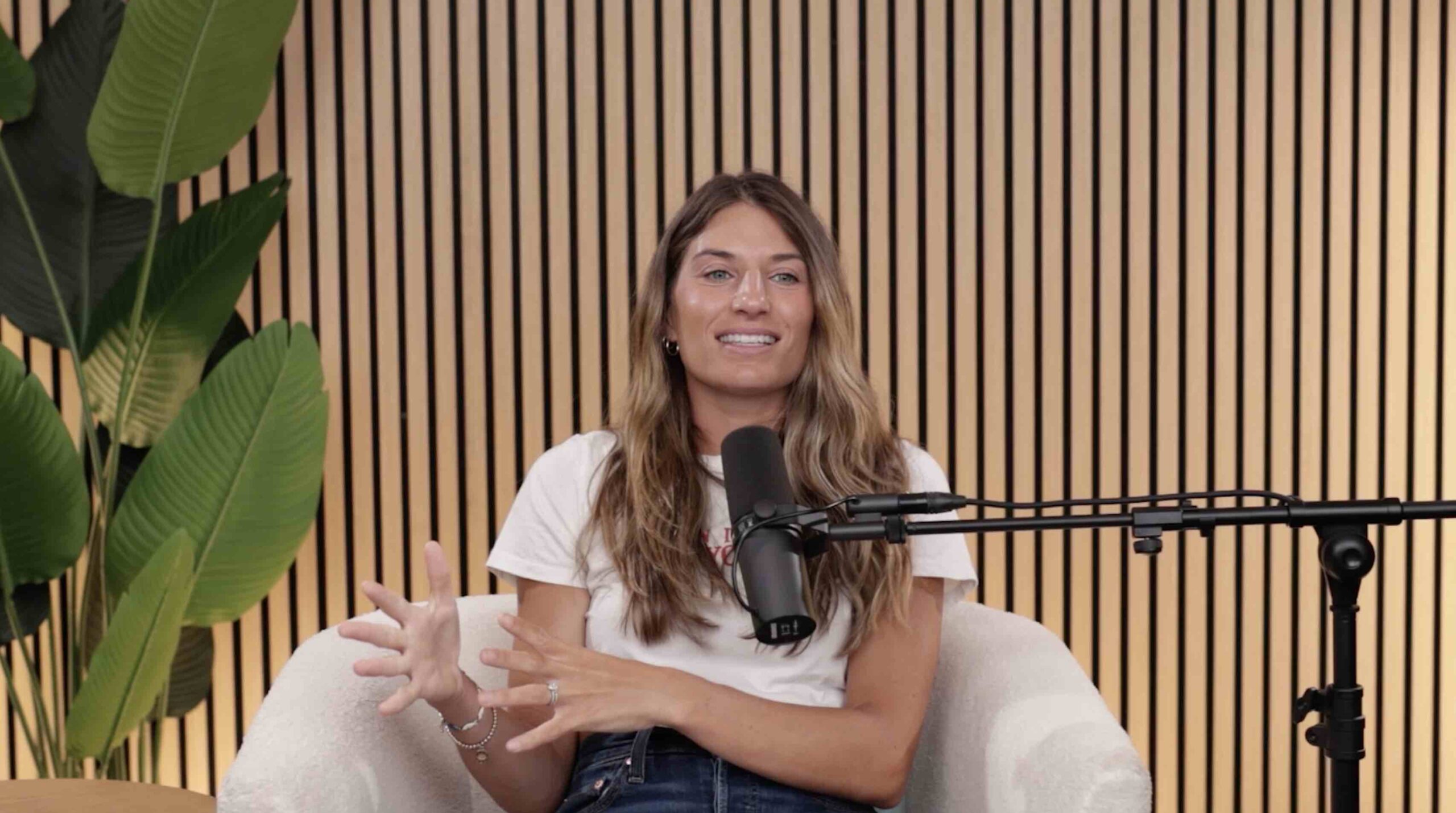


My business has always been rooted in spirituality and intuition. It started during my 200-hour yoga teacher training, three months of daily yoga, meditating, journaling, no drinking, fully vegan, completely immersive. I went in wanting to quit my corporate job but not knowing what my purpose was. Through that season of deep introspection, I found the next step to take, and that has been the foundation of everything I’ve built over the last nine years.
As my business grew and changed, and especially once I became a mom, that hour-long daily meditation practice stopped being realistic. But my interest in mindset and visualization never went away. In fact, visualization is the one practice I can point to that has changed my life and business more than anything else.
Today I want to walk you through the exact visualization practice I use. It has nothing to do with a giant vision board taking over your office wall or a 30-minute meditation every single morning. It’s simple, it’s fast, and it’s something you can build into your life even with almost zero extra time.
Prefer to listen? Tune in to Behind the Design Podcast on Spotify, Apple Podcasts or watch the YouTube video below!
Why 2025 Was the Year Everything I Visualized Actually Happened
In 2025, for the first time, I went all in on this exact practice. And nearly everything on my vision board happened. We spent two weeks in Italy. I hit my revenue goal. I ran in-person workshops after setting that as a goal with no clear plan for how. We even made the decision to move to North Carolina, and three months later, we did.
That was the moment I realized I was actually tracking results, and the results were real. Every time I’ve shared this approach with clients or friends, the reaction is the same: they want to know more. So let’s get into it.
Visualization vs. Manifestation: What’s Actually Happening Here
I went back and forth on whether to call this a manifestation episode or a visualization episode, because manifestation tends to get a bad reputation as just hoping something happens and waiting for it to show up. That’s not what this is.
Visualization puts action behind the vision. When you actually visualize what you’re doing, you’re training your brain to recognize and prepare for what comes next. As a lifelong athlete and former gymnast, I rehearsed routines in my mind over and over before ever performing them, so that by the time I actually did it, my brain already knew it was possible. High performers do this constantly, often with a coach dedicated purely to visualization and mindset work. There’s no reason we can’t build a simplified version of that into our daily lives.
The goal isn’t hope-and-pray manifestation. It’s visualizing your future self and then taking aligned action toward becoming her.
Step One: Build a Vision Board That Reflects Your Life, Not Just Your Wish List
Almost everyone has some version of a vision board, but here’s how I take mine a step further. I keep it in three places:
- A Pinterest board filled with images that align with my vision
- Printed photos from that board placed in the first few pages of a dedicated visualization journal (separate from my regular daily journal)
- My phone’s lock screen
Having it in three places matters because visualization doesn’t require a big block of time. If I don’t have time to sit down and journal, I can scroll my Pinterest board for 30 seconds or glance at my lock screen for five seconds and instantly reconnect with that bigger vision.
One important note on what actually goes on the board: for me, it’s rarely about specific tangible objects. It’s about an overall life and feeling. A waterfront home. Traveling with my kids. Having a podcast. Connecting with people. In the book The Five Types of Wealth, the author describes his North Star as swimming in the pool with his kids at 2:00pm on a Wednesday, because that image represents freedom, creativity, and time with the people he loves. That’s the kind of vision to build toward: not just tangible wins, but the life those wins are actually in service of.
Step Two: Journal Your Day as if It Already Happened
This is the piece I’d call non-negotiable if you can manage it even one or two times a week (more is better, and ideally four to five days).
Here’s how it works: you write out your day in your journal as if it has already happened, from the perspective of your future self. For example, I might write that I’m in the podcast studio, thrilled because we just hit 100,000 downloads, bringing my kids Lila and Archie along with me. None of it is true yet, but the practice puts you in that energetic state and, more importantly, it starts to shape the decisions you make from that place.
My favorite quote sums this up: “Goals are a place to come from, not a place to get to.” When you can clearly see who you want to become, you start making decisions as that person now, rather than waiting until you arrive to start acting like her. That shift filters everything, from pricing to client decisions to how you spend your Tuesday afternoon.
Step Three: Meditation and Affirmations, Simplified for Real Life
When I have time, I use a Joe Dispenza guided meditation (morning or night versions, 20 to 25 minutes) that’s entirely built around future visioning and decision-making from your future self.
But realistically, as a parent, a 20-minute uninterrupted meditation most mornings just isn’t happening. That’s where an affirmations app has become a daily staple. These range from three-minute to 22-minute audio sessions covering everything from wealth mindset to happiness, and you can listen while walking, driving, working out, or working. In just a few minutes, they shift your mindset and prime your brain to think from a future-focused, high-vibration state.
The underlying principle: the energy you’re putting out attracts more of the same. If your lens is constantly centered on lack, you’re closing the door on abundance. Shifting even a few minutes a day toward meditation or affirmations can meaningfully change the energy you’re operating from.
Step Four: Anchor It All in Gratitude
Future-self visioning is powerful, but without gratitude, it can tip into scarcity, chasing the next thing because you don’t feel like you or what you have is enough right now.
That’s why I close every day with my top three gratitudes. Sometimes I write them down alongside my to-do list. Other days I just think through them in the shower or car. The format matters less than the consistency of not ending the day without naming what you’re grateful for. Some people prefer doing this first thing in the morning, before even opening their eyes, as an easy habit to stack onto brushing your teeth.
Gratitude reframes desire itself. When my husband and I drive past waterfront homes we’d love to own one day, instead of feeling envious, we say, “We are so excited for the day one of these is ours.” That’s the shift: wanting something from excitement and anticipation, not from lack.
Step Five: Use a Mantra to Stay Grounded
A simple mantra connected to your vision can pull you back to center anytime you start to spiral or make decisions from fear instead of alignment.
Two of mine right now: “The more fun I have, the more money I make,” and “Clients love paying me in full.” When proposals are out and I catch myself worrying, that second mantra reminds me exactly where I want to be operating from, and more often than not, clients do pay in full.
The real power of this whole practice is that it becomes a filter for decision-making. Instead of lowering your prices because a client pushed back, or adding a service you don’t actually want because revenue felt slow one month, you ask what your future self, the one already living the vision, would actually do. She wouldn’t lower her prices. She wouldn’t add something misaligned. This is a long-term practice, not a quick manifestation trend. You’re visualizing the life, then taking aligned action toward it daily.
Books That Shaped This Practice
Two books fundamentally shaped how I think about visualization, especially during a season when I felt stuck between having my two kids close in age and questioning whether the life I was living was really mine:
- The Power of One More by Ed Mylett
- Level Up by Rob Dial (a more data-backed, scientific take on visualization)
I read them back to back, and looking back at where I was then versus now, the shift has been massive.
Start Small
If you take away one thing from this episode, let it be this: start with one piece. It doesn’t need to be an hour-long morning journaling ritual. It can be as simple as a five-second glance at your lock screen, a three-minute affirmation, or naming three things you’re grateful for before bed.
This practice, more than any strategy or system, has been the true center of how my life and business have transformed. Start small, stay consistent, and let your future self start making today’s decisions.



Comments +
Comments